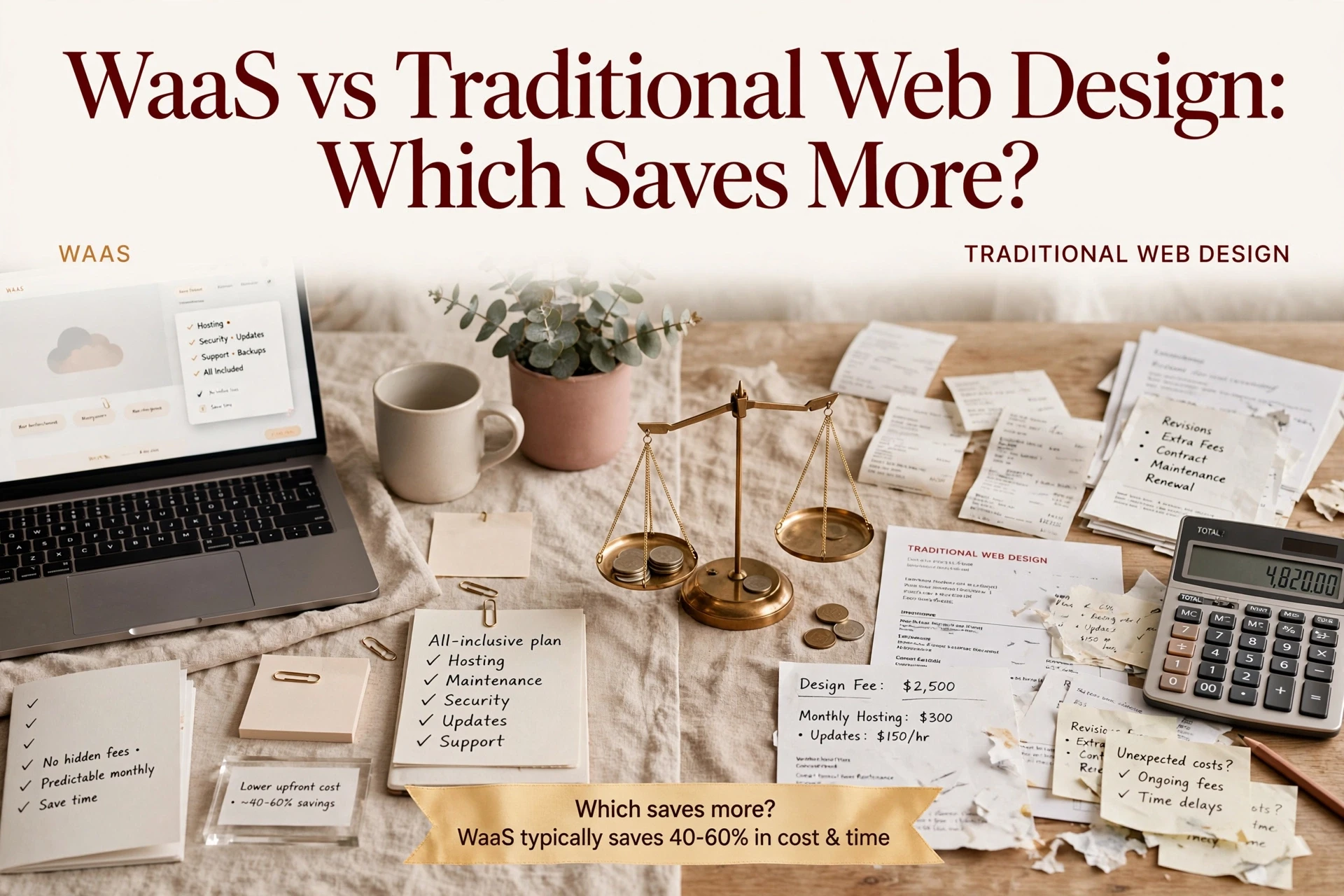
Quick Summary: WaaS usually costs less over three years and launches faster, with plans costing $99 to $299 per month and covering hosting, security, updates, backups, and support. Traditional web design costs $1,500 to $10,000 or more upfront and takes 6 to 12 weeks, but gives you full ownership of the code plus greater freedom for custom features and integrations. Choose WaaS for predictable pricing and hands-off maintenance, or a custom build when full control and specialized functionality matter more.
Ask anyone with a five-year-old custom site what it really costs: hosting, plugin updates, security patches and hourly tweaks dwarf the original build fee. WaaS turns that into one flat monthly price. This comparison stacks both models on cost over time, launch speed, maintenance, ownership and control, so you can pick with confidence.
WaaS vs Traditional Web Design at a Glance
| Website-as-a-Service (WaaS) | Traditional Web Design | |
|---|---|---|
| Upfront cost | Minimal or none; often a one-time setup or onboarding fee | Roughly $1,500 to $10,000+ for a small business site |
| Monthly cost | Typically $99 to $299 per month depending on features and support | Not required, but hosting plus maintenance typically adds $20 to $500+ per month |
| Time to launch | Days, sometimes under a week | Several weeks, often 6 to 12 for a full custom build |
| Ongoing maintenance | Hosting, SSL, updates, backups and support included | Billed separately by the hour or through a retainer |
| Ownership and control | Provider-managed; content and brand yours, code and stack usually not | Client owns the site and the code after handover |
| Best for | Small businesses, non-profits and professionals needing a reliable site fast | Businesses needing custom features, integrations or unique brand design |
How Website-as-a-Service (WaaS) and Traditional Web Design Compare
Website-as-a-Service (WaaS)
WaaS is a subscription website model: one provider designs, hosts, secures and maintains your site for a monthly fee. It suits small businesses, non-profits and professionals who need a reliable, done-for-you site fast, with build, hosting, updates and support bundled into one payment.
Key strengths
- Little or no upfront cost, usually $99 to $299 monthly
- Launch in days, sometimes under a week
- Hosting, SSL, backups and support included
Traditional Web Design
Traditional web design is a one-time project: an agency scopes, designs and builds a custom site, then hands it over. You own the code, but hosting and updates are billed separately. It fits businesses that need custom features, integrations or a unique brand design.
Key strengths
- Full ownership of site and code after handover
- Bespoke design and custom integrations
- No required monthly fee to the design agency
What Each Model Actually Costs You Over Three Years
| Cost | WaaS | Traditional |
|---|---|---|
| Upfront | $0 to small setup fee | $1,500 to $10,000+ |
| Monthly | $99 to $299 | $20 to $500+ |
| Three-year total | $3,564 to $10,764 | $2,220 to $28,000+ |
| Ownership | none, service-based | you own the site |
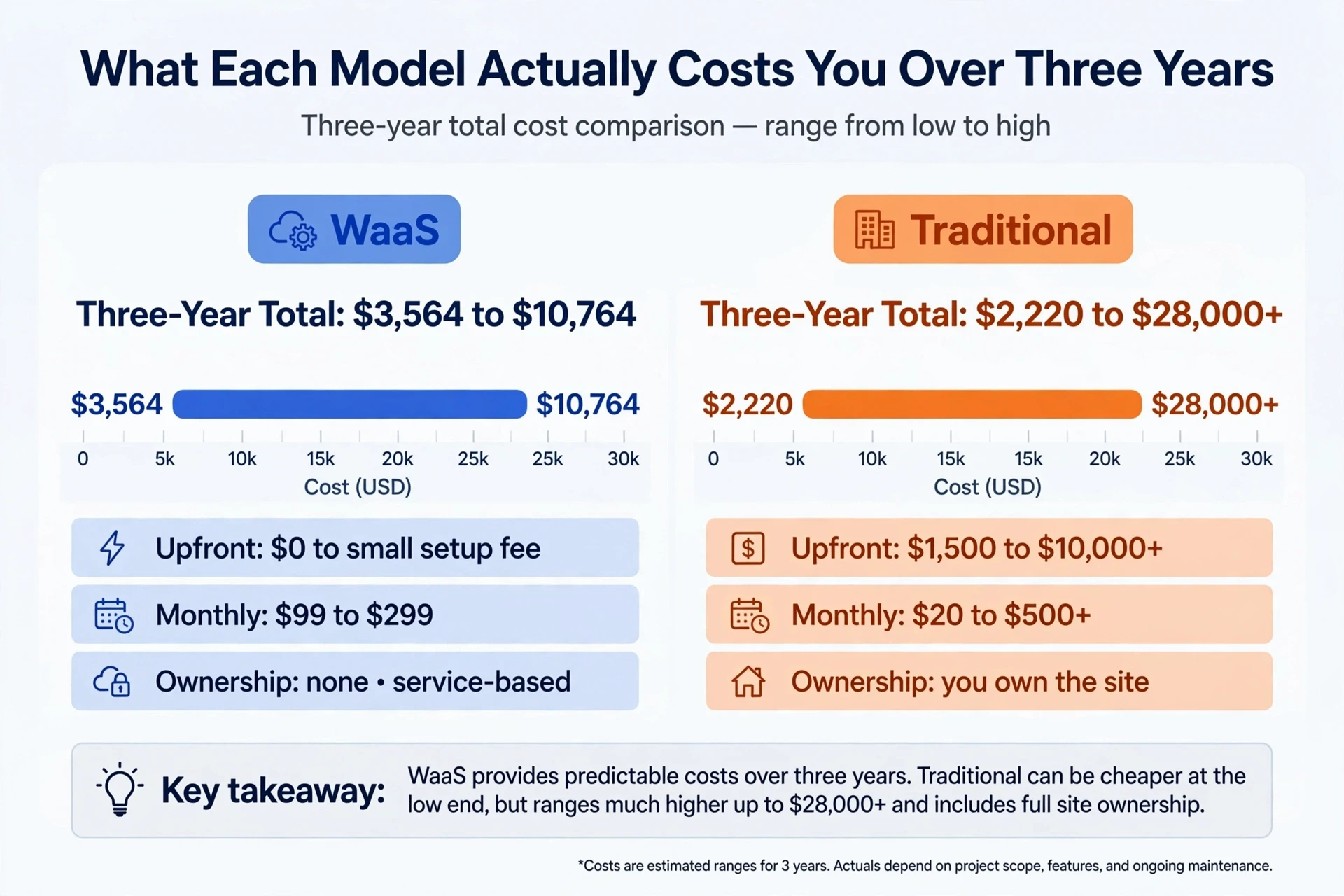
Small-business maintenance often runs higher than owners expect, around $50 to $500 a month according to Network Solutions. Hourly edits, updates, and renewals quietly stack up. A subscription website bundles that upkeep, which is why understanding what maintenance services should include matters before you compare totals.
Website as a Service vs Traditional Web Design: What Actually Changes Day to Day
The money math matters, but daily life with a subscription website differs most from a traditional build. Two areas show it clearly: launch speed and who handles the technical work after launch.

Speed to Launch and the Onboarding Difference
With a done-for-you subscription, a small site often launches in days because the platform, hosting and templates already exist. A traditional build takes 6 to 12 weeks: scoping, design drafts, revisions and development all stack up. This is how WaaS shortens that timeline.
Hosting, Security and Accessibility Compliance
After launch, the difference grows. Traditional sites leave hosting, updates, backups and fixes to you or a hired developer. A WaaS plan bundles website hosting and maintenance, so someone else patches security and keeps an ADA compliant website design current.
Control, Customization and What You Actually Own
Do you own your website with a WaaS provider? Usually not in the way a custom build works. The design, hosting and maintenance stay with the provider, and you cancel if you leave. You own your content and domain, so plan your exit before you sign.
When a Custom Build Is the Only Real Option
A custom build makes sense when you need complete ownership, complex integrations, custom software features or strict data rules that a subscription can’t cover. As WaaS explained shows, most small business sites don’t need that depth, so the trade-off is often worth it.
Which Should You Choose: WaaS or Traditional Web Design?
Pick WaaS if you need a site fast, want predictable monthly costs, and lack time or staff to manage updates. Pick a traditional build if you own the design outright, need heavy custom features, or expect no ongoing changes. Still unsure? Ask two questions: Can you fund $1,500 to $10,000 today? Will you handle hosting and upkeep yourself?
How to Make the Switch If You Already Have a Site
Migrating an existing site is straightforward. First, inventory your pages, then redirect old URLs so you keep search rankings. Next, move content and forms, and test everything on mobile. A provider offering website migration and redesign can handle the transfer, so your site stays live while the new one is built behind the scenes.

Still weighing the costs? Monkey Business handles design, hosting, and care for one flat monthly fee. Get your free quote today.
Frequently Asked Questions
Q1: Website as a service vs traditional web design?
WaaS costs $99-$299 monthly with upkeep included; traditional builds cost $1,500-$10,000 upfront plus separate maintenance.
Q2: Do I own my WaaS website?
No, the code stays with the provider, but your content and domain are yours.
Q3: When is a custom build better?
When you need full code ownership, complex integrations, or strict data rules.
Conclusion
Over three years, WaaS usually costs less and launches faster; a custom build wins on ownership and complex features. Match the model to your budget, timeline and technical support.