
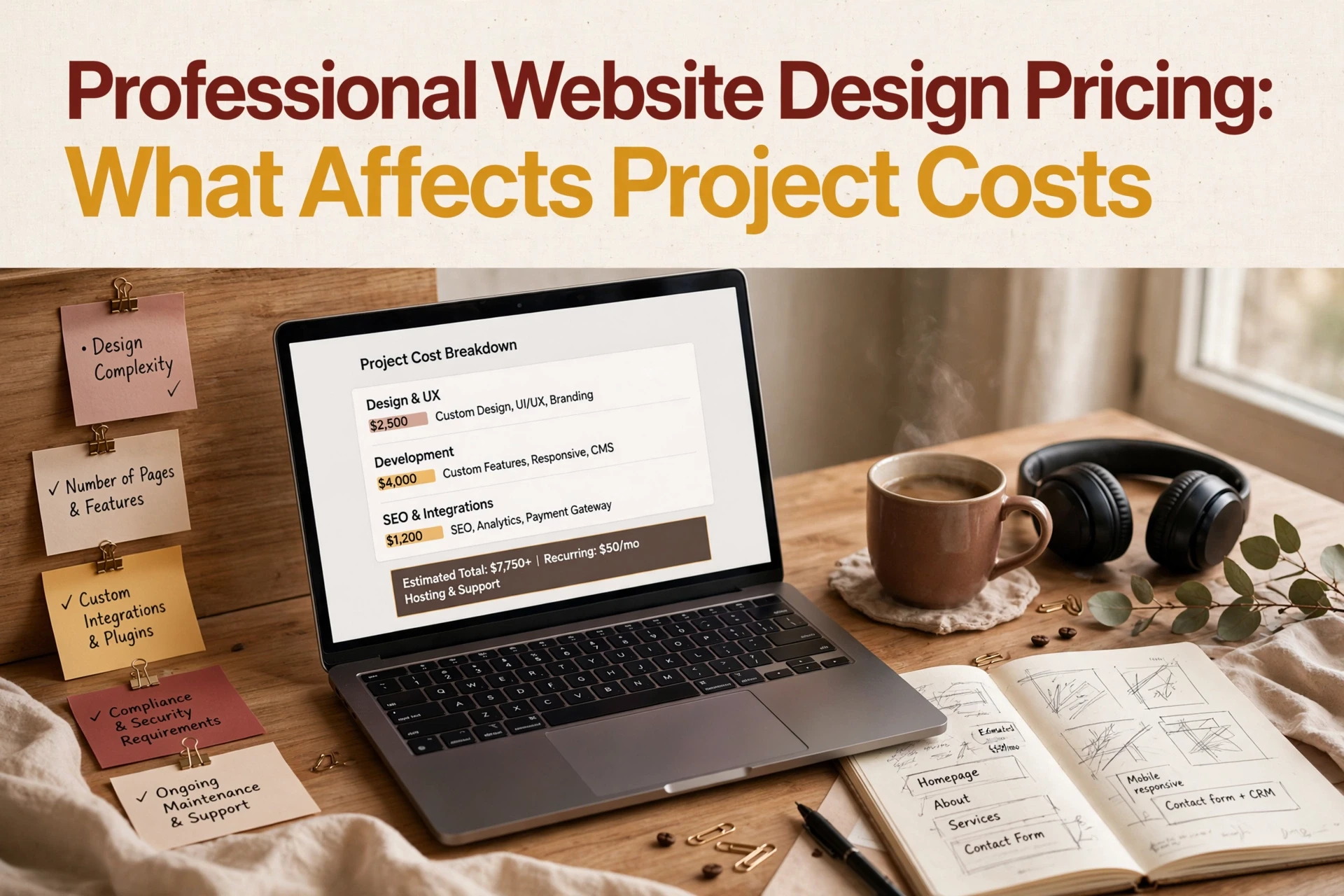
Quick Summary: Professional website design pricing varies widely because scope drives cost, not just looks. The biggest factors are project strategy, page count, custom design, and functionality like ecommerce or booking, with ecommerce alone often adding $3,000 to $10,000 for small sites. To get fair quotes, write a clear brief, ask providers to price the same scope, compare recurring costs like hosting and maintenance, and confirm ownership of files and accounts. For California small businesses and nonprofits, Monkey Business bundles design, hosting, and support into one flat monthly plan, which fits well if you want predictable costs.
Two proposals can look almost identical, yet one team prices research, original content, and integrations that the other skips. That gap makes professional website design pricing hard to compare. This guide ranks the cost factors in modern web design, explains project versus monthly pricing, and flags which providers fit different levels of scope – ranked by how broadly each factor shapes the work, effort, and after-launch care.
Website Design Cost Factors at a Glance
| Factor | Best for | What affects cost | Budget question |
|---|---|---|---|
| Project strategy and scope | Organizations needing a dependable project estimate | Discovery, research, planning, deliverables, and change control | What is in scope, and what is explicitly excluded? |
| Page count and site architecture | Teams comparing small brochure sites with larger websites | Unique templates, page volume, navigation, and migration | How many unique layouts and pages are included? |
| Custom design and brand requirements | Businesses with distinct brand and experience requirements | Original layouts, brand assets, interactions, and review rounds | Which design elements are bespoke, and how many revisions are included? |
| Functionality and integrations | Sites that need more than standard informational pages | Feature complexity, integrations, data flows, and testing | Which integrations and third-party fees are included? |
What to know about professional website design pricing
A price quote tells you what you’re paying for only if you know what’s inside it. Professional website design pricing covers far more than the interface you see: discovery, content, development, integrations, testing, and support after launch.
That’s why two modern web design quotes can differ by thousands and still be reasonable. Compare them with the same scope in hand, and split one-time build costs from recurring expenses like hosting, maintenance, and marketing.
Here are the factors that move your number.
1. Project strategy and scope
Every solid estimate starts with a business goal: leads, bookings, donations, sales, or credibility. Before design begins, a good team runs discovery work like audience definition, research, and sitemap planning, which takes time and shapes the price. If the brief changes after approval, new pages or features affect both budget and schedule.

Highlights
- Define your main audience and the one action you want visitors to take.
- Agree on deliverables, decision-makers, revision rounds, and project assumptions up front.
- Separate launch essentials from future enhancements so the quote stays reliable.
- A clear written scope prevents disputes, since both sides know what is included and excluded.
Specs
- Best for: Organizations needing a dependable project estimate
- What affects cost: Discovery, research, planning, deliverables, and change control
- Budget question: What is in scope, and what is explicitly excluded?
- Keyword lens: Scope drives the real cost behind any professional website design pricing quote, including modern web design builds.
Why it ranks here: Scope sits at the top because every other cost driver depends on what the site must accomplish and what the agency must deliver, from discovery through planning.
Last updated: September 26, 2026
Also Read: Professional Website Design vs Template-Based Sites
2. Page count and site architecture
A four-page site with a homepage, services, about, and contact is a much lighter build than one with service-area pages, staff profiles, and landing pages. Raw URL count matters less than the number of unique page templates, since each new layout needs its own design, content, and build effort.

Highlights
- Count unique page types as well as total URLs.
- Include navigation, redirects, and content migration in the estimate.
- Plan for reusable layouts where appropriate.
Specs
- What affects cost: Unique templates, page volume, navigation, and migration
- Budget question: How many unique layouts and pages are included?
- Best for: Teams comparing small brochure sites with larger websites
It ranks here because page scope is one of the clearest inputs to compare across proposals.
Last updated: September 26, 2026
Also Read: 10 Must-Have Professional Website Design Elements for U.S. Small Businesses
3. Custom design and brand requirements
A distinctive visual system and tailored layouts take more design and review time than a theme. Fully custom work sits at the top of the pricing range, while template builds stay low, and many quotes hide revision limits.

Highlights
- Ask whether the project uses a design system, theme, or fully custom layouts (Clutch pricing guide).
- Clarify if brand identity work is part of the website scope (Brand Vision guide).
- Confirm revision limits and approval milestones.
Specs
- What affects cost: Original layouts, brand assets, interactions, and review rounds
- Budget question: Which design elements are bespoke, and how many revisions are included?
It ranks here because visual customization directly drives design hours, and unclear approval steps often add rounds nobody budgeted for.
Last updated: September 26, 2026
Also Read: Blog | Monkey Business
4. Functionality and integrations
Interactive features turn a plain website into a working system, and each one adds development, setup, and testing. A contact form is simple; booking, payments, donations, or CRM links cost far more, and ecommerce work alone often runs $3,000 to $10,000 for smaller sites according to WebFX’s cost guide.
Highlights
- Document booking, payments, ecommerce, donations, and lead-routing needs.
- Identify third-party tools and their separate license fees.
- Include integration testing and who owns each account.
Specs
- Best for: Sites that need more than standard informational pages
- What affects cost: Feature complexity, integrations, data flows, and testing
- Budget question: Which integrations and third-party fees are included?
It ranks here because functionality can shift a mostly informational build into an integrated business system with a much larger technical scope.
Last updated: September 26, 2026
Also Read: Professional Website Design: 9 Elements Clients Notice
More factors that affect website project costs
Four scope drivers get most of the attention, but four more quietly shape what you’ll actually pay. Ask about each one before you sign.
- Content, copy, and photography – Confirm whether writing, editing, photo sourcing, and content entry are included or come from your team.
- Accessibility, SEO, and technical requirements – Check what accessibility checks, technical SEO setup, privacy tools, and testing the proposal really includes.
- Maintenance and post-launch support – Compare hosting, updates, backups, security, and included content edits over time.
- Provider and pricing model – Weigh one-time agency projects, freelancers, and managed subscriptions by deliverables, ownership, cancellation, and lifetime cost.
How to choose the right website design budget
Set yourself up for fair quotes before you contact anyone:
- Write a short brief first. Name your audience, business goal, required pages, and the actions visitors must take (call, book, donate).
- Ask every provider to quote the same scope, itemized across design, development, content, integrations, launch, and support.
- Compare full recurring costs, not just the project price: hosting, updates, maintenance, software, and support add up.
- Confirm ownership of the domain, files, content, analytics accounts, and subscriptions, plus transfer and cancellation terms.
- Match the model to your situation. Custom builds suit teams with in-house help. If you want one flat monthly payment with everything handled, a managed service is usually the better fit.
For California small businesses and nonprofits, Monkey Business bundles design, hosting, maintenance, and support into one done-for-you monthly plan, so there are no surprise invoices later.

Now that you know what drives web design costs, skip the surprise invoices. Monkey Business bundles design, hosting, maintenance, and support into one flat monthly plan. Get a clear quote today.
Frequently Asked Questions
Q1: Top agencies for high-end business websites?
Look for agencies that show transparent pricing, real client work, and ongoing support. Monkey Business offers done-for-you design, hosting, and maintenance in one plan, while firms like Jottful and Eversite serve similar needs.
Q2: Why do website prices vary so much?
Scope drives cost. Page count, custom features, copywriting, and compliance needs all add hours. A five-page site costs far less than a booking or e-commerce build.
Q3: What is Website-as-a-Service pricing?
Instead of one large upfront fee, you pay a flat monthly rate covering design, hosting, updates, and support. It spreads costs out and keeps your site maintained.
Q4: Should I budget for maintenance after launch?
Yes. Even a one-time project needs security updates, backups, and edits. Plan for ongoing care, or choose a subscription model that includes it.