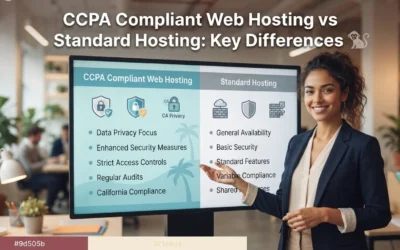
Quick Summary: CCPA-aware hosting bundles privacy essentials like service-provider DPA terms, opt-out link setup, deletion request support, and audit-friendly logs, while standard hosting leaves that work to the site owner. Even with a privacy host, duties such as privacy policy wording, consent notices, and answering consumer requests within California’s 45-day window stay on the business. Pick CCPA hosting if your site collects names, emails, or form submissions from California visitors, and standard hosting only when no personal data is captured. Monkey Business stands out by offering done-for-you CCPA-compliant hosting and maintenance, removing the manual privacy work for small business owners.
If your California site collects even one lead form a week, your hosting plan shapes how much CCPA privacy work you do yourself. Standard hosting leaves compliance on your plate. Privacy hosting builds much of it in. This guide compares the two directly, showing what privacy hosting handles for you, what still stays on your to-do list, and whether the upgrade fits your data risk.
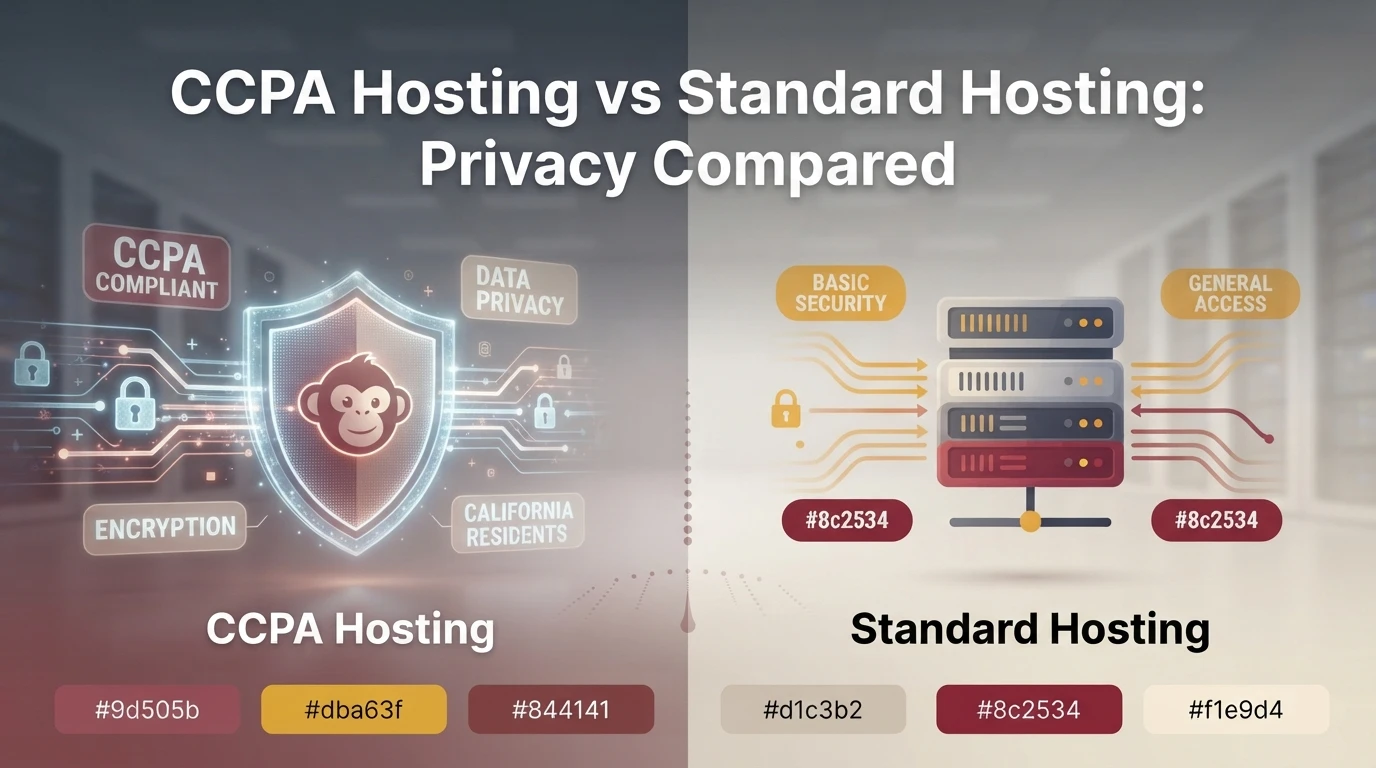
CCPA Hosting vs Standard Hosting: Privacy at a Glance
| CCPA compliant web hosting | Standard hosting | |
|---|---|---|
| Privacy controls | Built for opt-out, privacy policy, and tracking control support | Basic hosting controls, not compliance-focused |
| Data processing terms | Typically includes a CCPA-aware DPA with service-provider language | Often lacks CCPA-specific DPA language |
| Consumer rights support | Helps with access, deletion, and opt-out-of-sale requests | Mostly handled outside the host |
| Security and logging | Stronger monitoring, encrypted backups, and audit-friendly logs | Depends on plan and provider |
| Admin workload | Lower for the site owner | Higher for the site owner |
| Best fit | California businesses that collect personal data | Low-risk sites with simple data collection |
How CCPA compliant web hosting and Standard hosting Compare
CCPA compliant web hosting
This hosting tier is built around California privacy duties. It bundles a privacy-aware data processing agreement, opt-out and deletion request support, and audit-friendly logs, which suits businesses that collect personal data through their site. Think of it as privacy hosting with the compliance work mostly done for you.

Key strengths
- Lower admin workload for the site owner
- Stronger monitoring, encrypted backups, and audit-ready logs
Standard hosting
Standard hosting provides general-purpose server space and core site tools, with privacy work left largely to the owner. It often lacks CCPA-specific contract language and handles consumer requests outside the host. It fits low-risk sites with simple data collection.
Key strengths
- Broad provider choice and pricing
- Works well when no personal data is collected
Where CCPA Hosting Actually Changes Your Privacy Workload
What the host quietly handles for you
A privacy-focused host takes server-side jobs off your list: encrypting data in transit and at rest, keeping servers patched, logging access, and controlling where your data physically lives. Some plans include a Do Not Sell or Share link setup and a subprocessor list, which California requires you to disclose. Done-for-you setups such as ours bundle these with maintenance, so the core CCPA hosting features get checked without you touching a dashboard.
What still stays on your plate either way
Your host can’t answer consumer requests for you. When someone asks to know, delete, or opt out, you must find their data across forms, analytics, and vendors, then respond within California’s 45-day window. You also still need a plain-language privacy policy, consent notices for cookies and tracking tools, and training for whoever reads the inbox. Under the CCPA, those duties follow the business, not the hosting plan. Budget a few hours a month for them.
Privacy Features That Matter Most When You Compare Plans
Data processing terms you can actually read
Ask each host for its data processing agreement, or DPA. That is the contract stating how the host may use, keep, and share personal information on your behalf. Under the CCPA, a host only counts as your service provider if this contract is in place, so a vague policy is a real risk. Read it before you sign, not after an incident.

Backups, logs, and the paper trail you may need
Backups and server logs often hold personal data too, so ask where they live, how long the host keeps them, and whether deletion requests reach them. When someone asks to delete or opt out, you may have only California’s 45-day window to respond across every system. A host that documents what it stores, and can erase it on request, saves you that scramble.
Choose CCPA hosting if your site collects personal data like names, emails, or form submissions. Standard hosting works for simple brochure sites with no data capture. If you sell services in California, assume data flows through your site. Done-for-you providers such as Monkey Business bundle compliant hosting with maintenance, so the decision often comes down to how much privacy work you want to handle yourself.


Still chasing privacy requests across forms and vendors within California’s 45-day window? Monkey Business builds CCPA-compliant hosting and websites that handle it for you. Get started today.
Frequently Asked Questions
Q1: Compare compliant hosting services for California businesses?
Check three things: the data processing agreement’s CCPA language, deletion request support reaching backups and logs, and opt-out link setup. Strong plans bundle all three with monitoring and maintenance.
Q2: Do I still need a privacy policy with CCPA hosting?
Yes. Hosting supports compliance, but the plain-language policy, cookie notices, and staff training remain your responsibility under California law.
Q3: Is CCPA hosting worth the extra cost for a small business?
If your site collects names, emails, or form submissions, usually yes. It cuts the hours you spend on requests and reduces risk.
Conclusion
Standard hosting leaves CCPA work on your plate; privacy hosting builds much of it in. If your site collects names, emails, or form submissions from California visitors, compliant hosting with done-for-you maintenance cuts your workload and risk.