
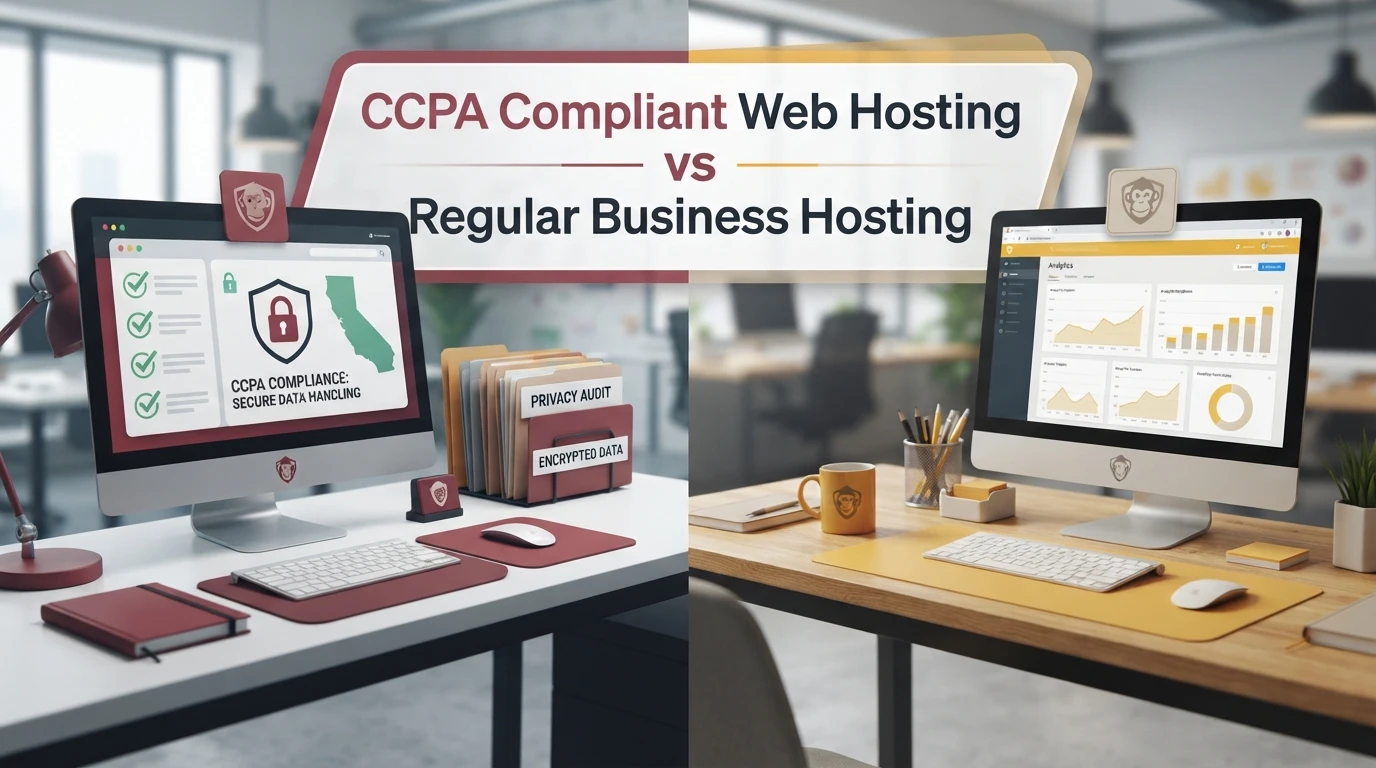
Quick Summary: Check whether your business meets the CCPA thresholds before choosing more expensive hosting. If you collect enough California residents’ data or share personal information, managed CCPA-compliant hosting can reduce technical work and risk by providing notices, consent tools, Global Privacy Control support, and maintenance, though legal responsibility still belongs to the business. If you fall below the thresholds and collect only basic contact details, regular business hosting with an honest privacy notice may be sufficient.
If you collect personal information through forms, ads, or analytics, CCPA compliant web hosting is the safer pick. Fall under the thresholds and manage the basics yourself, and regular business hosting works fine. New California Privacy Protection Agency rules took effect January 1, 2026, leaving many small business owners unsure what they actually need. As a California-based Website as a Service provider, we compare both models below, weighing cost, effort, and who carries the legal responsibility.
CCPA Compliant Web Hosting vs Regular Business Hosting: At a Glance
| CCPA compliant web hosting | Regular business hosting | |
|---|---|---|
| Privacy tooling included | Privacy policy, notice at collection, Do Not Sell or Share link, cookie consent and Global Privacy Control handling typically built in | Usually shared hosting basics only, TLS and a control panel, with no built-in privacy module |
| Cost and pricing model | Monthly subscription bundling design, hosting, privacy and maintenance, replacing several separate line items | Low monthly fee, but compliance tools, plugin licenses and legal templates cost extra |
| Setup and ongoing maintenance | Provider-managed updates, backups and privacy upkeep with less work on the business owner | Owner installs plugins, publishes policies and maintains them through every plugin update |
| Who carries legal responsibility | Still the business, but the provider supplies the technical infrastructure and documentation | Entirely the business, including proving what data is collected and where it lives |
| Best for | California small businesses, nonprofits and service pros that collect form, lead or ad-tracker data | Sites below the coverage thresholds that collect little or no personal information |
Meet the Two Hosting Options
CCPA compliant web hosting
Managed, all-inclusive California business hosting that builds privacy features into the site itself and maintains them for you. Providers such as Monkey Business bundle design, hosting and privacy upkeep into one monthly subscription, so the owner’s legal duty stays but the technical work is handled for them.

Key strengths
- Do Not Sell or Share link, notice at collection and Global Privacy Control handling typically built in
- Provider-managed updates, backups and privacy upkeep
Regular business hosting
Standard self-serve hosting sold on speed, uptime and price, where privacy compliance becomes your own project. You install the plugins, publish the policies and keep them current through every update.
Key strengths
- Low monthly fee and simple setup
- Full control over tools and configuration
How Does CCPA Compliant Hosting Differ from Regular Business Hosting?
CCPA compliant hosting bakes California privacy rules into the service itself. Regular business hosting just stores your website files and keeps them online. It rarely touches legal duties, while compliant hosting ships the technical pieces the law expects.
What the hosting provider actually handles
A compliant plan typically includes encryption in transit and at rest, a notice at collection, a Do Not Sell or Share link, Global Privacy Control support, and a data processing agreement. You sign one contract instead of building each piece yourself.
Where regular business hosting quietly falls short
Standard hosts give you a login, a server, and support tickets. Privacy features become do-it-yourself projects: consent tools, data deletion workflows, breach response plans. Each one costs hours or contractor fees, and a missed piece is a compliance gap. The features to check are easy to list, harder to build alone.
Are You Even Covered by the CCPA in 2026?
The CCPA applies to your business if it meets any one of these thresholds:
- Over $25 million in annual revenue
- Buying, selling, or sharing personal data of 100,000 or more California residents or households
- Deriving 50% or more of revenue from selling personal data
Most small sites that only collect contact forms fall outside these thresholds.

The threshold tests that decide it
Check your revenue, data volume, and data-selling share once a year. If a threshold applies, your business hosting plan alone won’t satisfy the law. You need policies, notices, and data handling controls, not just a server that sits in California.
The January 1, 2026 rules and what they mean for a small site
The California Privacy Protection Agency’s new rules took effect January 1, 2026. Key dates: annual risk assessment attestations due April 1, and initial cybersecurity audits and assessments due December 31, 2027. If you’re out of scope, focus on honest privacy notices instead of CCPA compliant web hosting upgrades.
What Compliant Hosting Costs You in Time and Money
Is CCPA compliant hosting more expensive than regular hosting? Upfront, yes, often by $10-40 per month. Over three years, bundled managed website hosting usually wins, because the gaps in regular hosting turn into billable hours.
The hidden cost list inside regular hosting
Count what plain business hosting leaves out: privacy policy updates, SSL and encryption setup, backups, breach response help, and developer time for each fix. At $80-150 an hour, a few hours a quarter erases the price gap.

What a bundled managed plan replaces
A flat managed plan folds hosting, maintenance, compliance updates, and support into one monthly fee, as covered in this CCPA hosting plans comparison. This is the model Website as a Service providers like Monkey Business build on, so your total cost stays predictable.
Which Should You Choose: CCPA Compliant or Regular Business Hosting?
Choose compliant hosting when
Pick CCPA compliant web hosting if you meet a revenue or data threshold, sell or share personal information, or serve many California residents. Ask what data your forms, analytics, and cookies actually collect. A done-for-you compliant website handles notices and controls for you.
Regular business hosting still works when
Regular hosting suits you if you stay under the thresholds and collect only basic contact details. You still need a simple privacy notice and a way to honor requests. Review your data practices yearly, because growth can pull you into scope.

Not sure where your business lands under the 2026 CCPA rules? Monkey Business handles hosting, compliance, and maintenance for you. See how it works at Monkey Business.
Frequently Asked Questions
Q1: How does CCPA compliant hosting differ from regular business hosting?
Compliant hosting builds in privacy tools like a Do Not Sell or Share link and Global Privacy Control handling. Regular hosting just stores your files; compliance becomes your project.
Q2: Do small businesses really need CCPA compliant hosting?
Usually no. Most contact-form-only sites fall under the 2026 thresholds, so a plain host with an honest privacy notice works.
Q3: What are the key 2026 compliance deadlines?
Risk assessment attestations are due April 1, and initial cybersecurity audits by December 31, 2027.
Q4: Can I upgrade from regular hosting later?
Yes. Review your data practices yearly and move to a managed compliant plan once growth pulls you into scope.
Conclusion
Check your thresholds first. If you’re in scope, CCPA compliant web hosting saves hours and lowers risk. If not, regular business hosting with honest notices is enough.