
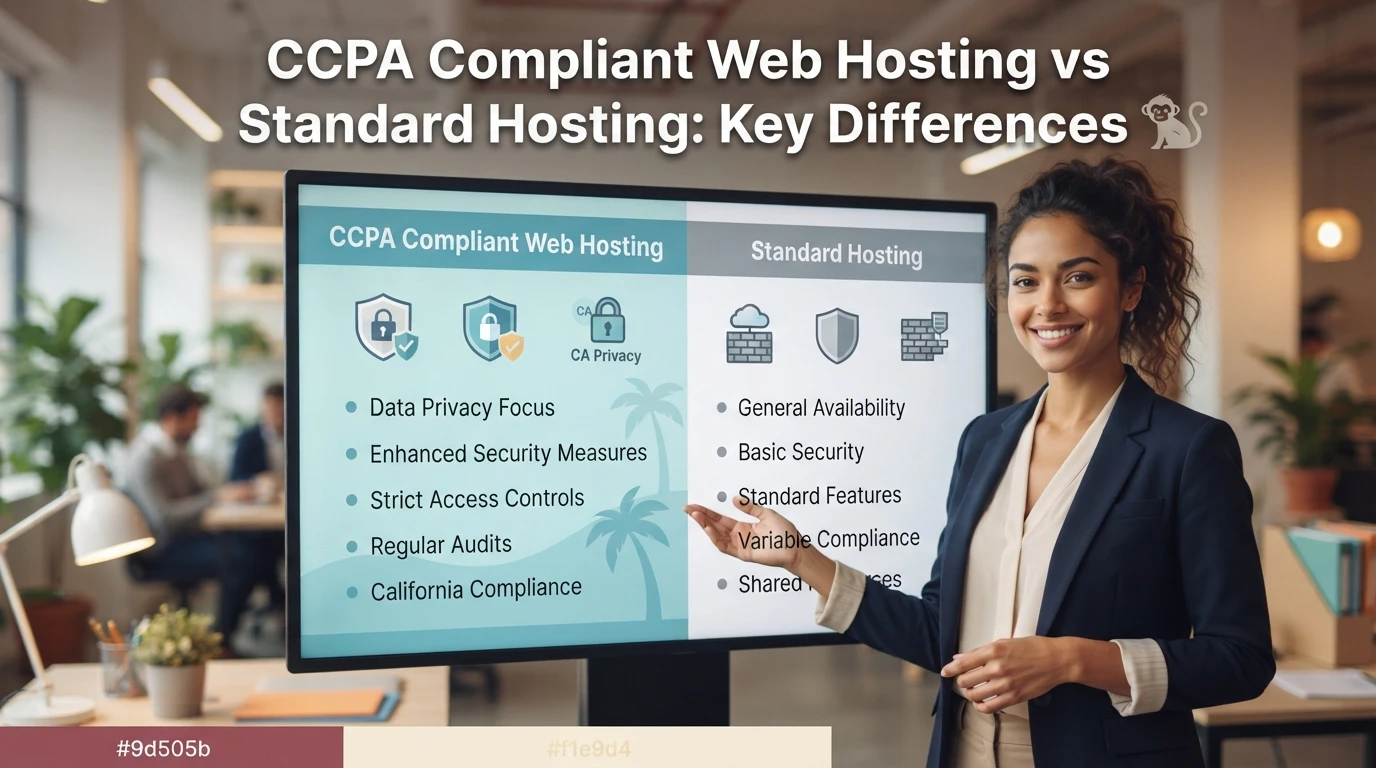
Quick Summary: Under the CCPA, the legal privacy duty always stays with the business, not the hosting provider, so the question is how much server-side work your host takes on. CCPA compliant hosting bundles data processing agreements, US-based data storage, audit records, encrypted logging, and consumer request handling into the plan, while standard hosting leaves notices, deletion requests, and recordkeeping to the site owner. Standard plans fit low-risk sites like brochures with minimal data collection; once you collect names, payments, or health details from California residents, the compliance risk gets heavy fast. Monkey Business is positioned as a done-for-you option that folds CCPA hosting, design, and ongoing compliance maintenance into one plan for California small businesses.
If your California website collects even one name, email, or phone number, CCPA rules already apply. Standard hosting leaves every privacy task on your plate. Compliance hosting handles notices, deletion requests, and records for you. This comparison shows what each tier shifts, so you can pick the compliance hosting that fits.
CCPA Compliant Hosting vs Standard Hosting: At a Glance
| CCPA compliant web hosting | Standard hosting | |
|---|---|---|
| Who carries the privacy duty | Business still owns the duty; the host absorbs most server-side work | Business owns everything, including the privacy plumbing |
| Data and contract terms | Service-provider language and DPA terms aligned with CCPA | Generic terms; rarely CCPA-specific DPA language |
| Consumer request handling | Built to support access, deletion, and opt-out workflows | Handled outside the host, usually by hand |
| Security and monitoring | Stronger logging, backups, patching, and audit support | Varies by plan; usually basic |
| Admin workload | Lower for the site owner | Higher for the site owner |
| Best fit | California businesses collecting personal data from real people | Low-risk sites with little to no personal data |
How CCPA compliant web hosting and Standard hosting Compare
CCPA compliant web hosting
Compliance hosting builds California privacy controls, security patching, and service-provider contract terms into the server setup. It suits California businesses that collect personal data from real visitors. You still own the legal duty, but the host absorbs most of the server-side work.

Key strengths
- Built to support access, deletion, and opt-out requests
- Stronger logging, backups, and audit support
- Lower admin workload for the site owner
Standard hosting
Standard hosting gives you server space and core tools, but the privacy plumbing stays your job. Generic contract terms rarely include CCPA-specific language, so consumer requests get handled by hand. It fits low-risk sites with little or no personal data.
Key strengths
- Lower upfront cost
- Wide provider choice
- Simple setup for basic sites
Where the Privacy Duty Actually Lives
Here is the part hosts rarely say out loud: under the CCPA, the legal duty sits with your business, not the hosting company. The law treats you as the business collecting consumer data, so you own the privacy policy, the consumer requests, and the records.
The host reduces work, it does not replace your duty
A compliant host gives you secure servers, encryption, and tools that make compliance easier. That is real help, but it is help, not a handoff. You still decide what data to collect, post an accurate privacy notice, and honor delete or opt-out requests within legal deadlines. A managed privacy compliant website service like Monkey Business bundles those duties with hosting, so nothing falls between providers.

What Changes Day to Day: Data, Security, and Consumer Requests
Contracts, data location, and audit support
With standard hosting, you sign the terms and manage privacy duties yourself. A CCPA compliant host gives you a data processing agreement, keeps personal data in the United States, and supplies records you can show during an audit. That paperwork shift matters when a complaint lands. It moves much of the legal burden to a provider built for it.
Security, logging, and responding to requests
Day to day, compliance shows up in monitoring. A compliant host logs access, encrypts data, and helps you answer consumer requests to delete or share information within California’s deadlines. Standard hosting leaves you tracking emails and spreadsheets. Done-for-you providers such as Monkey Business fold these tasks into website maintenance, so requests get handled on time.
When Each Option Actually Pays Off
Stay on standard hosting when the risk is small
If your site is a brochure with a contact form and no tracking beyond basics, standard hosting works. Just add a plain privacy notice and skip analytics tools that sell visitor data.
Upgrade to compliant hosting when you handle real data
Collect names, payments, health details, or lead forms from California residents? Then the legal duty lands on you. Compliant hosting shifts the technical burden to a provider, and services like CCPA compliant web hosting handle it for you.

Which Should You Choose: Compliant or Standard?
Serve California residents and collect any personal data? Choose CCPA compliant hosting, because the legal duty to protect that data lands on you, not your host. Standard hosting costs less, but it leaves you holding the compliance risk alone. If you serve only outside California and keep data minimal, standard plans can work fine.

Not sure which host carries your legal duty? Monkey Business handles CCPA-compliant hosting, design, and care in one plan. Visit Monkey Business and let us take that burden off you.
Frequently Asked Questions
Q1: CCPA compliant hosting vs regular hosting?
CCPA compliant hosting includes privacy tools like consent banners and data access support. Regular hosting does not, so the legal duty falls on you.
Q2: Does compliant hosting make my site CCPA compliant?
Not alone. You still need a privacy policy, cookie consent, and a process for consumer requests.
Q3: Who handles CCPA updates on my site?
Monkey Business maintains compliance features for clients, so rule changes are handled for you.
The Verdict
Standard hosting gives you servers. CCPA compliant hosting gives you a partner who carries the privacy duty with you. For California small businesses, that difference decides who answers when consumers ask.